
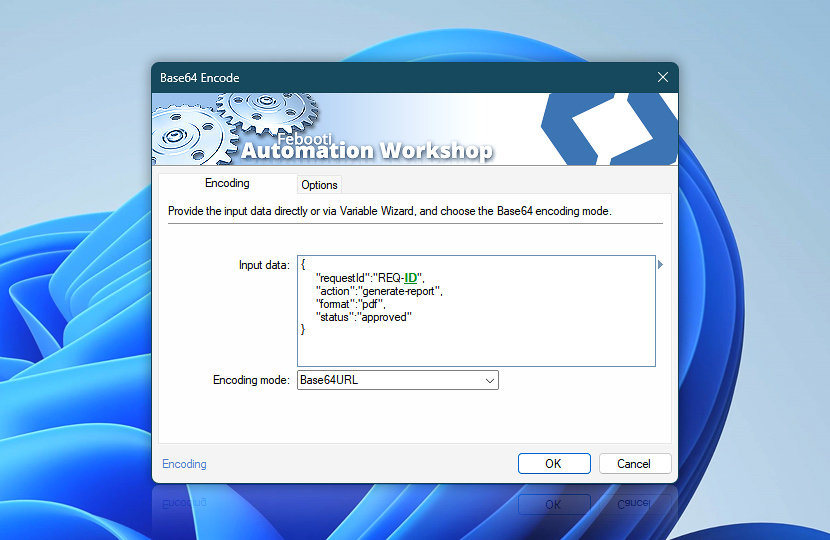
 This is an upcoming feature. Base64 Encode is planned for general availability in version 10.1.
The Encoding tab of the Base64 Encode Action specifies the source data and the Base64 encoding variant to use. Base64 converts data into a text-based representation that can be safely transferred or stored by systems designed primarily for text.
Provide the input directly or dynamically through the Variable Wizard, and then choose between standard Base64 and the URL-safe Base64URL format. Output formatting, including line breaks and padding, is configured separately on the Options tab.
| Encoding | Details |
|---|---|
| Input data | Specifies the data to convert into a Base64-encoded string. Enter text directly or use the Variable Wizard to provide dynamic content from files, Triggers, previous Actions, variables, and other sources. |
| Encoding mode | Specifies which Base64 alphabet is used to encode the input data:
|
| Variable Wizard |  Use dynamic data input—substitute a parameter from a file, web, connected Trigger, other Actions, date and time presets, etc. Use dynamic data input—substitute a parameter from a file, web, connected Trigger, other Actions, date and time presets, etc. |
Interconnect
- Base64 Encode integration and auditing—Variables (dynamic data) and Events (recorded activity). Use Variables to encode data produced by connected Triggers or previous Actions, and use Events to track successful or unsuccessful encoding for auditing and workflow control.
More encoding…
Along with the Base64 Encode Action, Automation Workshop includes a set of related tools within the Encoding family designed to help process and transform data across different workflows.
- Base64 Decode · Overview · Variables
- URL Encode · Overview · Variables
- HTML Encode · Overview · Variables
Notes
- Base64 is an encoding format, not encryption. It does not protect sensitive data from being read or decoded.
- Choose the encoding mode required by the receiving system. Standard Base64 and Base64URL use different character sets and may not be interchangeable in every context.
Questions?
If you have any questions, please do not hesitate to contact our support team.