
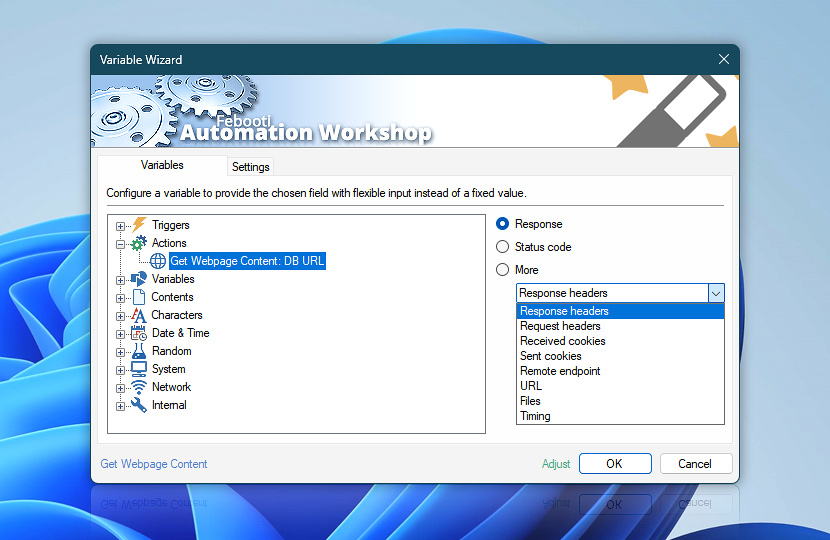
The Get Webpage Content Action retrieves webpage, API, or text-based content and makes the returned data available for later workflow steps. Use these variables to inspect the response, check the server status, read headers and cookies, or pass retrieved content to other Actions.
Variable Wizard provides quick access to the response body, HTTP status code, headers, cookies, remote address details, and timing information. Request and response headers can be selected from presets or referenced by custom header names when your workflow needs specific values.
| Variable | Details |
|---|---|
| Response | Contains the response body returned by the server, such as webpage content, plain text, HTML, JSON, XML, or other structured text-based data retrieved by the Get Webpage Content Action. Use this value to process, store, compare, extract, or pass retrieved content to later Actions.
Examples:
|
| Status code | Returns the status code received after the Get Webpage Content Action request is processed. Use this value for simple comparisons in Compare Action. Quickly detect successful requests, redirects, and communication failures. Examples:
|
| More… | Additional variables provide extended request and response details for the Get Webpage Content Action. Use them to validate communication, analyze metadata, monitor redirects, and troubleshoot web requests.
Use these values to troubleshoot requests, follow redirects, validate server behavior, analyze response metadata, and build advanced webpage or API processing workflows. |
| Adjust() | Streamline creation of Task workflows even further—instantly make quick variable adjustments such as in-place text replacement (all, first, or last), ensuring (starts, ends, or does not), trimming (whitespaces, quotes, etc.), or changing capitalization. Chain multiple adjustments. Optionally, set a different display name. |
Automatic list processing…
The Get Webpage Content variables returned as lists (even multi-level) can be automatically processed in further Actions. Use the For Each Action to parse a given text string (any list variable) and sequentially retrieve its elements one by one · see list processing examples. Or, use the Split Text and Lookup Text Actions to access list elements by their indices.
Ask for more…
If you have any questions, please do not hesitate to contact our support team.