
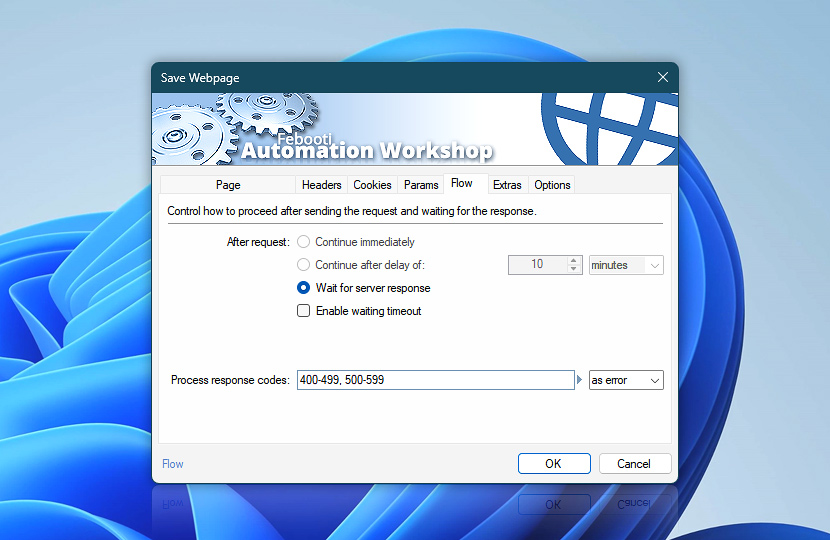
Define how the Save Webpage Action behaves when retrieving and storing webpage content. Control whether execution continues immediately, waits for a response, or applies a delay depending on how the saved content is used in your workflow.
These settings also determine how response codes and timeouts are handled, helping ensure reliable page capture when working with dynamic content, slower websites, or complex page structures · Flow handling explained
| Flow | Details |
|---|---|
| After request | After the Save Webpage Action sends a request, choose how the workflow should proceed:
Waiting is recommended when the webpage must be fully retrieved before saving or further processing. Immediate continuation is suitable for lightweight or non-critical page captures. |
| Enable waiting timeout | Optionally, to prevent an unintended workflow lockdown (in case the Save Webpage Action is waiting indefinitely), set the Do not wait longer than timeout value option and choose a procedure to perform when On timeout is reached… |
| On timeout | Choose behavior if the Save Webpage Action times out:
|
| Process response codes | Define how specific server response codes are handled during execution:
Handle HTTP response codes (such as 404, 500, or 503) based on how critical successful webpage retrieval is for your workflow. |
| Time units |  Define and set a time frame in your preferred format—be it milliseconds, seconds, minutes, hours, or days. Define and set a time frame in your preferred format—be it milliseconds, seconds, minutes, hours, or days. |
| Variable Wizard |  Use dynamic data input—substitute a parameter from a file, web, connected Trigger, other Actions, date and time presets, etc. Use dynamic data input—substitute a parameter from a file, web, connected Trigger, other Actions, date and time presets, etc. |
Note
- Currently, the Wait for server response option is the recommended and fully supported flow control option.
We are here to help…
If you have any questions, please do not hesitate to contact our support team.